Renting or Buying a Campervan for Your Working Holiday in New Zealand
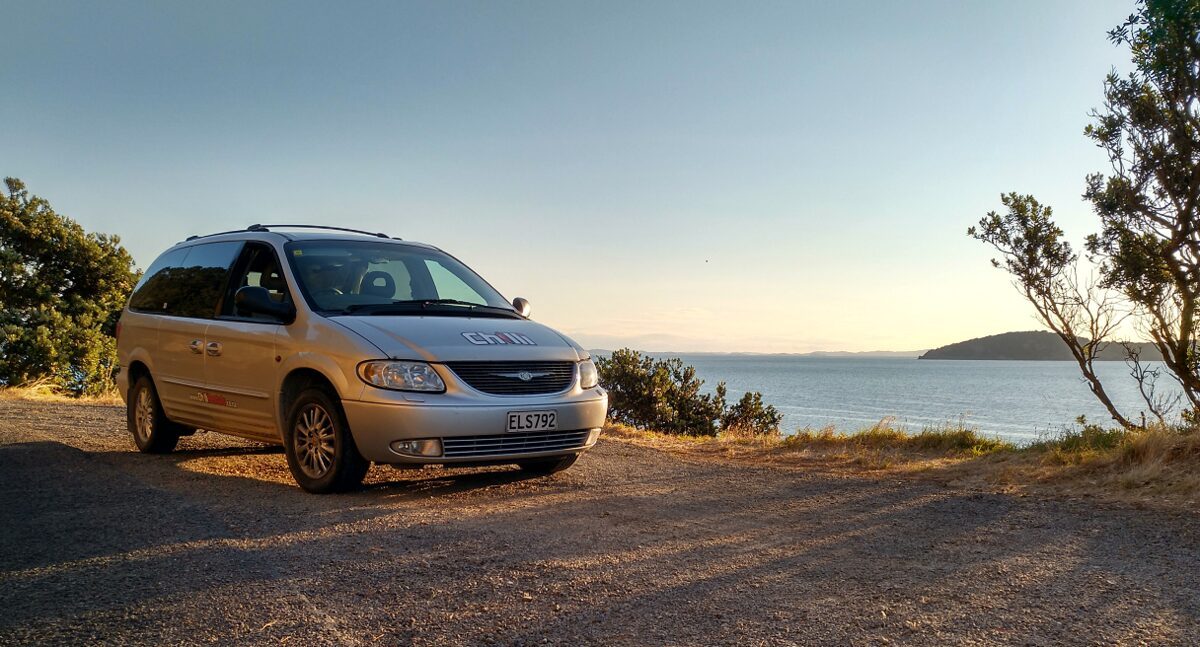
Renting is cheaper for trips up to about eight weeks. From roughly two months on the road, buying a campervan with a guaranteed buyback is usually cheaper, and the longer you stay the bigger the gap gets. The reason is simple: a rental charges you for every single day, while a presale purchase costs you the same fixed amount whether you keep the van for two months or ten.
Almost everyone who comes to New Zealand on a working holiday visa ends up asking this question, usually somewhere around week three, when the rental invoice starts to look like a rent payment. This guide gives you the numbers, the four scenarios that cover most travellers, and the practical details nobody mentions until you are already committed.
The one number that decides it
Forget daily rates for a moment. What matters is your net vehicle cost, and the two models calculate it completely differently.
Renting: daily rate multiplied by the number of days. Day 1 costs the same as day 180. The meter never stops.
Presale purchase: purchase price minus the guaranteed buyback. That difference is fixed on the day you sign. Keep the camper for eight weeks or eight months and the number does not move.
Take the Budget Camper at 7,995 NZD with a guaranteed buyback of 50 per cent. Your net cost is roughly 4,000 NZD, full stop. A compact rental at 49 to 75 NZD a day passes that figure somewhere between week eight and week twelve, depending on the season you travel in.
What it actually costs, side by side
Rental figures below use the compact class at 49 NZD a day off-season and 75 NZD a day in peak season. The presale column uses the Budget Camper at 7,995 NZD with a 50 per cent guaranteed buyback. Both are guide figures; a personal quote for your dates will be more precise.
| Length of stay | Renting | Buying, net after buyback | Cheaper |
|---|---|---|---|
| 4 weeks | 1,370 - 2,100 NZD | approx. 4,000 NZD | Renting, clearly |
| 8 weeks | 2,750 - 4,200 NZD | approx. 4,000 NZD | Roughly even |
| 3 months | 4,450 - 6,800 NZD | approx. 4,000 NZD | Buying |
| 6 months | 8,900 - 13,600 NZD | approx. 4,000 NZD | Buying, by a wide margin |
| 12 months | 17,900 - 27,400 NZD | approx. 4,000 NZD | Buying, no contest |
Two things stand out. First, the buying column never changes. Second, the break-even sits earlier than most people expect, and it moves earlier still if you travel in peak season or want a bigger vehicle, because rental rates scale with both and the purchase net cost does not.
Four scenarios that cover most travellers
1. Four weeks of holiday, then home
Rent. No paperwork, no ownership, hand the keys back and fly out. Buying at this length means paying for flexibility you will never use.
2. Three months, one season of work, then home
Buy. At three months the numbers already favour a purchase, and if you are following a harvest you will want the freedom to move on short notice. See when the work actually happens in our guide to the fruit picking season.
3. Six months or more, working as you go
Buy, without much hesitation. Over six months the rental column runs to five figures while the purchase stays flat. This is the classic case the presale model was built for.
4. "I honestly do not know how long I am staying"
Buy, as long as you are fairly sure of at least eight weeks. This is the scenario people get wrong most often. They rent because their plans are vague, then extend twice and end up paying far more than a purchase would have cost. A guaranteed buyback applies at any point inside the agreed window, so an open-ended plan is an argument for buying, not against it.
What buying involves that renting does not
Owning the vehicle means owning its running costs. That is the honest trade-off for not paying a daily rate.
WOF and rego. The WOF (Warrant of Fitness) is the technical inspection, due every six or twelve months depending on the age of the vehicle. Rego is the registration, paid in blocks of three, six or twelve months. Both are valid at handover, and you renew whichever one expires during your trip. Neither is expensive or complicated.
Insurance. Third-party cover is not legally required in New Zealand, which surprises most Europeans. Get it anyway. Damage to someone else's vehicle is the one cost that can genuinely wreck a trip budget.
Repairs. A ten-year-old van driven across gravel roads will need something at some point. You pay for it, but you also pay no rental fee, and 4,000 NZD of net cost leaves a lot of headroom for a workshop visit.
The change of ownership. Registered with the New Zealand transport authority, filled in at handover. New Zealand deliberately keeps vehicle purchase easy for travellers: no citizenship or residency required, a working holiday visa is enough.
What renting gives you that buying does not
Zero responsibility. If the alternator dies on a rental, you make one phone call and it becomes somebody else's problem. If it dies on your own van, you organise the workshop. For a short trip that peace of mind is worth real money, which is exactly why renting wins under two months.
The detail that shifts the maths: self-contained
A certified self-contained camper lets you freedom camp wherever the local council allows it. Over a long stay this is often a bigger lever than the vehicle cost itself. A holiday park with power and showers can run 25 to 50 NZD a night for two people. Basic DOC sites cost a few dollars. Freedom camping costs nothing.
Over six months, even a modest shift towards free and DOC sites saves more than the difference between renting and buying. If you are staying long, a self-contained vehicle is worth paying up for; every presale model above the entry-level Budget Camper is certified.
The practical angle nobody puts in a price table
If you are working seasonal jobs, your vehicle is also your accommodation, and that changes the calculation in ways money alone does not capture. Many orchards, vineyards and farms let workers park on site. Turning up self-sufficient, with your own bed and kitchen, makes you easy to employ. It also means you are not tied to hostel availability in a town where every bed is booked out during harvest.
And when the work finishes early or a better contract comes up three hours down the road, you simply drive there. No rental extension, no return date to renegotiate. If you are still working out where the work is, start with our overview of backpacker jobs in New Zealand.
What happens if your plans change
With a rental, an early return usually means you have already paid, and a late return means renegotiating, if the vehicle is even still free.
With a presale purchase, the buyback is agreed for a timeframe rather than a single date. Fly out after ten weeks instead of six months and you still get the agreed amount. You are also not obliged to use the buyback at all: backpacker campers sell well privately in Auckland, Christchurch and Queenstown at the end of a season, and you will often get more that way. The guarantee is your floor, not a ceiling.
Quick checklist
- Staying under about eight weeks? Rent.
- Staying two months or more? Buy with a guaranteed buyback.
- Not sure how long? Buy, as long as eight weeks is realistic.
- Want zero responsibility for a vehicle? Rent, even on a longer trip.
- Staying long and watching the budget? Insist on self-contained.
- Travelling in December or January? Book or enquire months ahead either way.
Still not sure?
Send us your travel dates and we will work out both options and tell you which one is cheaper for your trip, including the case where that answer is renting. Start with a rental enquiry or look at the presale campers and their buyback prices.


